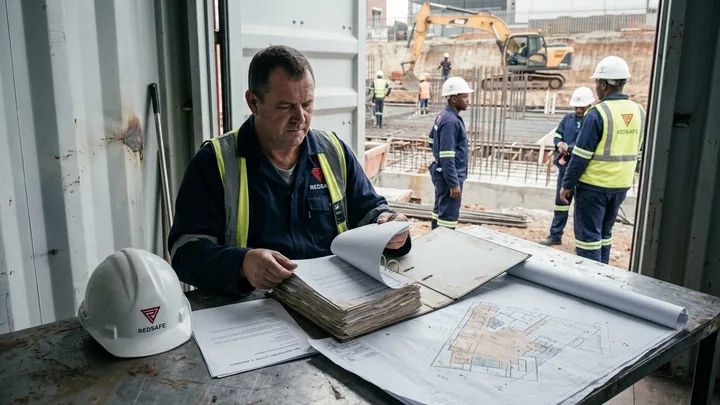

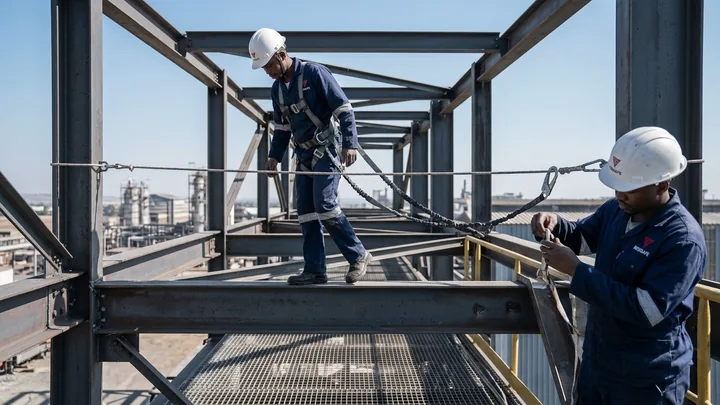
Falls from height remain one of the most common causes of serious injury and death on construction sites and operating plants. In South Africa, the Construction Regulations, 2014, issued under the Occupational Health and Safety Act, require a contractor to have a fall protection plan wherever there is a risk of a person falling. This article sets out what that plan has to cover, and what clients, principal contractors and site supervisors should check before anyone climbs.
Who prepares the plan
The regulations place the duty on the contractor, who must designate a competent person to prepare the fall protection plan for the work. The plan is not a generic policy. It is specific to the site and the activity, it must be implemented and maintained for as long as the work continues, and it must be amended when conditions change: a new work area, a different access method or a change in the sequence of erection.
A fall protection plan typically forms part of the contractor's health and safety file and is reviewed by the principal contractor before the work starts.
1. Risk assessment of all work at height
The plan starts with a risk assessment of every activity carried out from an elevated position. It should identify:
- Each task done at height, and the height and duration involved
- Leading edges, open sides, floor openings, fragile roofs and skylights
- Access and egress routes, including ladders, stairs and temporary access
- Falling-object hazards to people working or passing below
- Environmental factors: wind, rain, poor lighting and work near live plant
The assessment drives everything that follows. If a hazard is not identified here, it will not be controlled.
2. The hierarchy of control
Fall protection follows the same order of preference as any other risk. The plan should show that each option was considered before moving down the list.
| Level | Control | Examples |
|---|---|---|
| 1 | Eliminate the work at height | Assemble steelwork or pipe spools at ground level and lift into place; use extended tools from below |
| 2 | Collective protection that prevents a fall | Guardrails, edge protection, covered openings, scaffolds and mobile elevating work platforms |
| 3 | Work restraint | A harness and lanyard set so the worker cannot reach the edge |
| 4 | Fall arrest | Harness, energy-absorbing lanyard or self-retracting lifeline, rated anchor; safety nets |
| 5 | Administrative controls | Exclusion zones, permits, supervision and signage |
Collective measures protect everyone without relying on individual behaviour, so they are preferred over personal fall arrest. Fall arrest stops a fall that has already happened, so the plan must account for fall clearance: the free fall distance, lanyard deployment, harness stretch and a safety margin, measured against the distance to the ground or the next obstruction.
3. A rescue plan
A worker who is held by a harness after a fall still needs to be brought down quickly. Prolonged suspension can cause suspension trauma, so the regulations require the plan to include a procedure for rescuing a person who has fallen and is suspended. A credible rescue plan names:
- The rescue method for each work area (rescue kit, mobile platform, rope access)
- Who is trained to carry it out, and who is present on each shift
- The equipment, where it is kept and how it is inspected
- How emergency services are called, and the access route for them
- First aid and medical follow-up for the person rescued
Calling the emergency services is not a rescue plan on its own. The response time has to match the hazard.
4. Equipment selection and inspection
Harnesses, lanyards, connectors, self-retracting lifelines and anchors must be suited to the task and compatible with each other. The plan should require a pre-use check by the user and periodic inspection by a competent person, with a register that tracks each item by serial number. Any equipment that has arrested a fall is withdrawn from use until it has been inspected and cleared, or is discarded. Anchor points need a known capacity, either designed or tested.
5. Training and fitness
The plan must cover the training programme for people working at height and for those who supervise and rescue them. It must also address workers' physical and psychological fitness to work at elevated positions. In practice this means a medical fitness assessment by an occupational health practitioner that specifically covers work at height, renewed at the interval the site requires, with the certificate kept on file.
6. Scaffolding
Scaffolds are the most common collective measure on industrial sites. They must be erected, altered and dismantled under the supervision of a competent person, and inspected before first use, after alteration or bad weather, and at regular intervals while in use. SANS 10085-1 (design, erection, use and inspection of access scaffolding) is the standard most commonly referenced in South Africa. A tagging system at each access point shows whether a scaffold is safe to use.
How Redsafe helps
Redsafe's HSE service covers risk assessments, health and safety files, audits and the placement of SACPCMO-registered, NEBOSH-qualified HSE officers on site. Redsafe's own management system is ISO 45001 certified. Talk to our HSE team about your next scope at height.
This article is general guidance. Always work from the current Construction Regulations, the applicable standards and your site's own requirements.