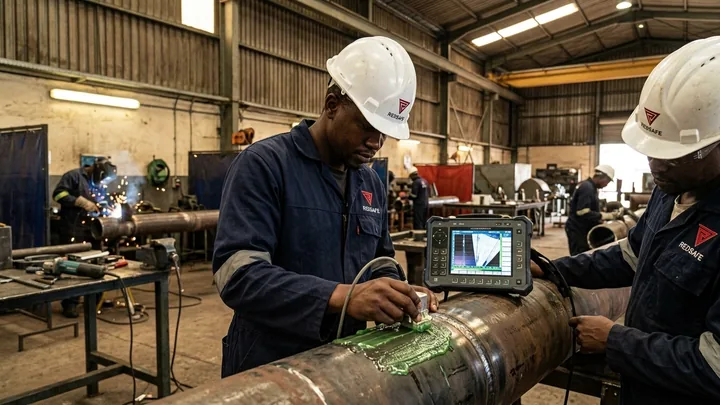


Hydrogen cracking often shows up hours after welding, below the surface, and sometimes only after the NDT window has closed. Thermal control is the main defence: preheat, interpass temperature and post-weld heat treatment (PWHT). Welding engineers, QC inspectors and anyone buying fabricated pressure or structural components need to understand why these temperatures are specified and how to prove they were achieved.
Why preheat: hydrogen and hardenability
Hydrogen-induced cold cracking needs four things at the same time:
- Diffusible hydrogen in the weld, from moisture in consumables, flux, the joint surface or the atmosphere
- A susceptible microstructure, typically hard martensite in the heat-affected zone (HAZ)
- Tensile stress, from shrinkage and joint restraint
- A low temperature, near ambient, after welding
Preheat works on the first two. It slows the cooling rate, which reduces HAZ hardness, and it keeps the joint warm long enough for hydrogen to diffuse out.
How readily a steel hardens is estimated with a carbon equivalent (CE). The widely used IIW formula is:
CE = C + Mn/6 + (Cr + Mo + V)/5 + (Ni + Cu)/15
with each element in weight percent from the mill certificate. A higher CE means a greater tendency to harden and a higher preheat requirement.
What drives the preheat temperature
| Factor | Effect on required preheat |
|---|---|
| Higher carbon equivalent | Increases |
| Greater combined thickness at the joint | Increases (faster heat sink) |
| Higher hydrogen level of the consumable or process | Increases |
| Lower heat input | Increases (faster cooling) |
| High restraint | Increases |
| Low-hydrogen consumables, correctly stored and dried | Reduces |
Methods for selecting preheat, such as those in EN 1011-2 and AWS D1.1, combine these factors. The final value must appear on the qualified welding procedure specification (WPS).
Measuring preheat and interpass temperature
Temperatures are measured on the parent metal near the joint, at a distance and location defined in the procedure. ISO 13916 is the common reference for how to measure. Typical tools:
- Temperature-indicating crayons, which melt at a rated temperature. Use one crayon to confirm the minimum preheat and a second to confirm the maximum interpass has not been exceeded. Use low-chloride and low-sulphur products on stainless and nickel alloys.
- Contact thermometers and thermocouple probes, which give a reading that can be recorded.
- Infrared thermometers, which are quick but depend on emissivity settings, so they are less reliable on bright or oxidised surfaces.
Preheat must be reached through the full thickness and around the full circumference before the arc is struck, and maintained throughout welding.
Maximum interpass temperature
The interpass temperature is the temperature of the weld area just before the next pass. The minimum is normally the preheat. A maximum is also often set, because excessive heat build-up can:
- Reduce toughness in quenched-and-tempered and fine-grained steels
- Increase sensitisation and distortion in austenitic stainless steels
- Take the joint outside the conditions qualified on the procedure qualification record (PQR)
Welders control this by pausing, sequencing joints or balancing welding around a component.
PWHT: what it does
Post-weld heat treatment heats the completed weld to a controlled temperature below the lower transformation range, holds it, and cools it at a controlled rate. Its main purposes are to:
- Relieve residual stresses from welding
- Temper hard HAZ and weld metal microstructures, which improves toughness and reduces cracking risk
- Help diffusible hydrogen escape
- Improve dimensional stability for later machining
- Reduce susceptibility to some forms of environmentally assisted cracking, which is why some process services specify PWHT regardless of thickness
Code-driven requirements
Whether PWHT is mandatory depends on the code, material and thickness. In ASME B31.3, the PWHT table (Table 331.1.1 in recent editions) sets requirements by P-Number and nominal wall thickness. It gives the holding temperature range and minimum holding time, and in some cases allows exemptions. Pressure vessel codes have their own equivalent rules. Client specifications often add requirements for particular services, such as a hardness limit.
PWHT is an essential variable in welding procedure qualification, so the PQR must reflect the heat treatment applied in production.
Recording the heat cycle
A defensible PWHT record includes:
- Thermocouple positions, sketched on a drawing and attached to the component
- Heating rate, holding temperature, holding time and cooling rate, from a calibrated chart recorder or data logger
- For local PWHT, the heated band, soak band and insulation widths
- Joint and weld numbers, so each chart traces to specific welds
- Post-PWHT hardness testing where required
The chart goes into the quality data book with the WPS, NDT reports and pressure test records.
At Redsafe
Redsafe's welding is carried out to qualified WPS/PQR, with QCP data books holding NDT reports and ITPs, and its team includes a Quality & Welding Specialist with more than 20 years' experience. See our fabrication and welding and piping capabilities, or send us your welding requirements.
Preheat, interpass and PWHT values must come from the qualified WPS, the applicable code edition and the client specification. This article is general guidance only.