

Pressure vessels, process piping and boilers store large amounts of energy, and in South Africa their design, manufacture and use are regulated by law. Plant owners, engineers, fabricators and procurement teams all need to understand where the Pressure Equipment Regulations (PER) apply and what role the Approved Inspection Authority (AIA) plays. If this is overlooked, completed equipment cannot be put into service. This article gives a general overview.
The legal framework
The PER are issued under the Occupational Health and Safety Act, 1993 (Act 85 of 1993) and administered by the Department of Employment and Labour. They apply to the design, manufacture, operation, repair, modification, maintenance, inspection and testing of pressure equipment. The regulations place duties on several parties:
- The manufacturer, who must design and build to a recognised health and safety standard and have conformity assessed
- The user (usually the plant owner), who must operate and maintain the equipment safely, keep records and arrange in-service inspection
- The AIA, who carries out the conformity assessment and inspection functions the regulations require
The regulations are supported by guidance notes and by South African National Standards that are incorporated by reference.
What an AIA is
An Approved Inspection Authority is an inspection body approved by the chief inspector of the Department of Employment and Labour to carry out inspections under the PER. Approval depends on accreditation by SANAS, the South African National Accreditation System, as an inspection body for the relevant scope.
An AIA is independent of the manufacturer and the user. Its scope of approval defines the types of equipment and the activities it may certify, so always confirm that the AIA you appoint is approved for the specific equipment and activities you need.
Categorisation under SANS 347
The amount of AIA involvement depends on the equipment's hazard category. SANS 347, Categorization and conformity assessment criteria for all pressure equipment, is used to categorise pressure equipment based on factors such as:
- The type of equipment (vessel, piping, steam generator)
- The fluid group, where dangerous fluids are treated more strictly than non-dangerous ones
- Whether the fluid is a gas or a liquid
- The maximum allowable pressure and the volume or nominal size
Low-hazard equipment may fall under sound engineering practice, with no formal categorisation. As the category rises, the conformity assessment becomes more rigorous and the AIA's involvement increases.
Where the AIA is involved
| Stage | Typical AIA involvement |
|---|---|
| Design | Review and verification of the design against the selected code, such as ASME VIII, ASME B31.3 or EN 13445, depending on category |
| Materials and welding | Review of material certificates, welding procedures (WPS/PQR) and welder qualifications |
| Manufacture and fabrication | Inspection at defined hold and witness points in the inspection and test plan |
| Pressure testing | Witnessing the test and signing the test record |
| Documentation | Review of the manufacturing data book and certification of conformity |
| In service | Periodic inspection and testing at intervals set in terms of the regulations, and inspection after repairs or modifications |
The exact extent depends on the category, the design code and the AIA's approval scope. That is why the AIA should be appointed and the inspection and test plan (ITP) agreed before fabrication starts. Hold points that were never notified cannot be witnessed after the event, and retrospective acceptance is costly or sometimes impossible.
Practical points for projects
- Categorise early. Agree the SANS 347 category for each item or line at design stage, because it drives the conformity assessment route.
- Appoint the AIA at the start, and confirm its approval scope covers the equipment.
- Build the ITP around AIA hold points, and give adequate notice for each.
- Keep traceability intact: material certificates, weld maps, NDT reports and pressure test records should all link to each component.
- Hand over a complete data book, because the user needs it for registration, operation and future in-service inspection.
- Involve the AIA in repairs and modifications on existing equipment, not only new builds.
At Redsafe
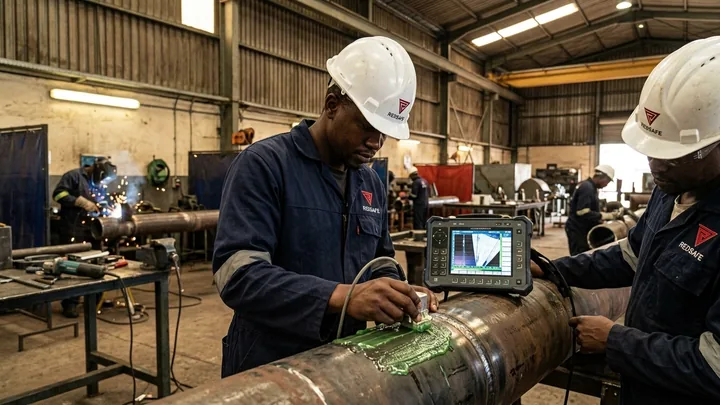
Redsafe's QA/QC programme includes qualified WPS/PQR, QCP data books with NDT reports, hydro-test logs and ITPs, and AIA sign-off. On the Sasol DHT plant supply and return lines, pressure testing was AIA-signed. See our piping and fabrication and welding capabilities, or send us your scope.
This is a general overview, not legal advice. Always refer to the current Pressure Equipment Regulations, the incorporated standards and your appointed AIA for project-specific requirements.