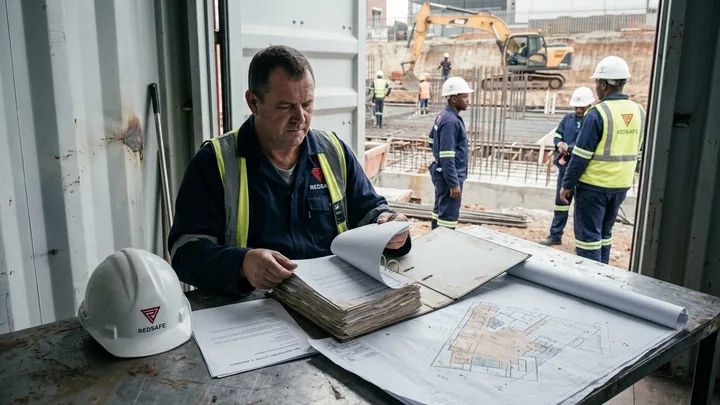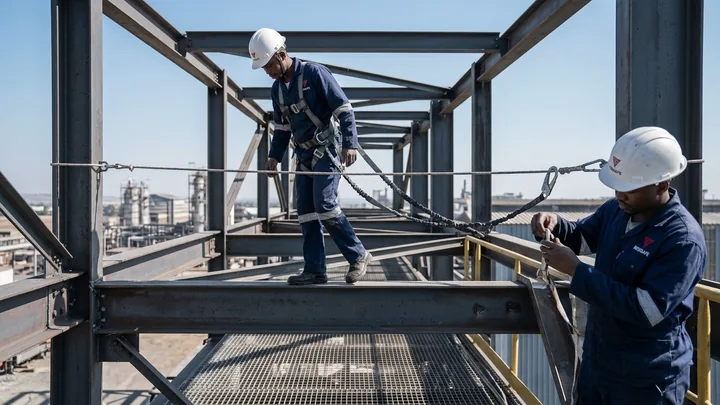


Choosing the wrong contractor costs far more than a higher tender price. Rework, safety incidents, delays and contractual disputes usually trace back to a contractor who could not do what the tender said they could. Prequalification filters bidders before price is considered, so that only contractors with the legal standing, systems and capacity for the work are invited to tender. This checklist is for procurement officers, project managers and HSE practitioners setting up or reviewing a vendor pack.
1. Company and statutory documents
These confirm that the contractor exists, is compliant and can legally employ people on your site.
| Document | What to check |
|---|---|
| CIPC registration | Registered name and number match the tender, directors listed, company active |
| Tax compliance status | A valid SARS tax compliance status PIN, verified online rather than accepted as a printout |
| COIDA letter of good standing | Issued by the Compensation Fund or a licensed mutual association, current for the contract period |
| B-BBEE certificate or sworn affidavit | Level, issuing agency or affidavit, expiry date, and whether ownership figures match your procurement targets |
| CIDB grading (where applicable) | Required for public-sector construction work; check the class of works (for example CE or ME) and grade against the contract value |
| Bank confirmation letter | Account in the company's own name |
2. ISO certificates and their scope
An ISO certificate is only as useful as its scope. For ISO 9001 (quality), ISO 45001 (occupational health and safety) and ISO 14001 (environment), check:
- The certification body, and whether it is accredited
- The expiry date and the date of the last surveillance audit
- That the scope statement covers the work you are buying, for example fabrication and installation rather than only supply
- That the certificate is in the name of the entity that will sign the contract
3. HSE performance and the SHE file
Past safety performance is a strong predictor of future performance. Request:
- Lost-time injury figures for recent years, with the man-hours they are based on
- A sample health and safety file from a comparable project, including the risk assessments, method statements and appointments
- The HSE policy and the incident investigation procedure
- Registration and qualifications of the safety personnel who will be on site
- Evidence of competent person appointments relevant to the scope: scaffolding, lifting, work at height, excavations
Look at the quality of the sample file, not only whether it exists. Generic, copied risk assessments are a warning sign.
4. Quality management
For fabrication and installation, ask how quality is controlled and recorded:
- Inspection and test plans (ITPs) with hold and witness points
- Qualified welding procedure specifications (WPS) with supporting procedure qualification records (PQR), and welder qualification records
- Material traceability from mill certificate to installed item
- A sample quality control data book from a completed project, with NDT reports and pressure test records
- Arrangements for third-party inspection, including an Approved Inspection Authority for pressure equipment where the regulations require one
5. Insurance
Confirm the cover is current and the limits suit the risk: public liability, professional indemnity where the contractor carries design responsibility, cover for the contractor's own plant and assets, and contract works cover where the contract makes the contractor responsible for it. Ask for broker confirmation, not only a policy schedule.
6. Financial capacity and references
Audited or reviewed annual financial statements show whether the contractor can carry the cash flow of your project. Check turnover against the contract value, and whether the contractor can provide a performance bond or guarantee if the contract requires one. Call at least two references for work of similar scope and size, and ask specifically about programme, safety, quality documentation and close-out.
7. Site or workshop visit
Documents show what a contractor says. A visit shows what they do. Walk the workshop or a live site, look at housekeeping, equipment condition, welding practice and record keeping, and meet the people who will run your project.
What Redsafe can provide
Redsafe holds a Level 1 B-BBEE rating and is ISO 9001, ISO 45001 and ISO 14001 certified. It carries public liability, professional indemnity and asset insurance, has audited financials and performance bonding capacity, and works with qualified WPS/PQR, QCP data books with NDT reports, hydro-test logs and ITPs, and AIA sign-off. See our engineering and procurement and HSE capabilities, or request our documents with your enquiry.
This checklist is general guidance. Your organisation's procurement policy and any applicable legislation take precedence.